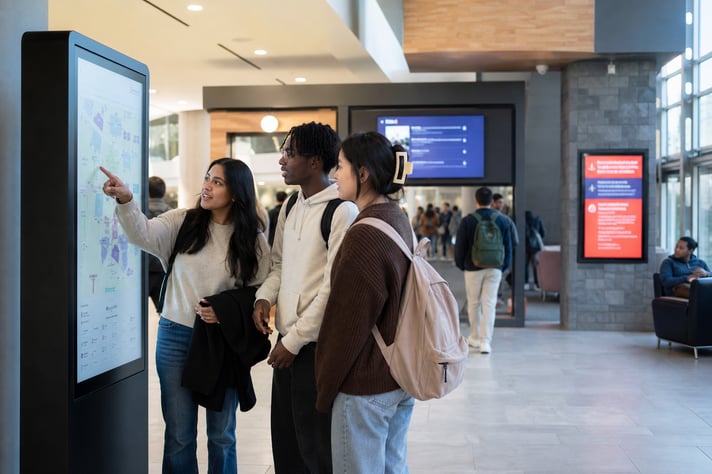
Why campus digital signage can improve wayfinding, safety, and student engagement.
At a Glance
Modern campus digital signage functions as a dynamic, location-aware communication ecosystem that cuts through digital noise to connect students, faculty, and visitors. Rather than serving as mere visual upgrades, networked displays streamline navigation through interactive wayfinding, drive student life via targeted event promotion, and reinforce safety with automated emergency overrides. To maximize this technology investment, higher-education institutions are moving away from passive loops and designing content around concrete, location-specific outcomes.
Long-term ROI relies on strong operational governance and reliable AV integration. By balancing centralized brand standards with localized publishing workflows, universities can ensure content remains fresh and engaging. Solutionz, Inc. helps colleges and universities design, deploy, and maintain secure, scalable digital signage networks—offering end-to-end expertise from initial system design to proactive managed support services.
Why campus digital signage matters more now
Campus digital signage is often discussed as a visual upgrade, but its real value is communication. In higher education, students, staff, faculty, and visitors move through dozens of buildings, events, deadlines, and service touchpoints every day. Important information competes with email overload, social feeds, posters, and word of mouth. A well-planned digital signage network helps institutions cut through that noise by delivering timely messages where people already are. For universities, digital signage becomes part of the student experience, campus operations, and institutional brand.
Digital displays can help first-year students find buildings, remind commuters about deadlines, promote student life events, reinforce safety messaging, and support emergency communications. They can also make campuses feel more modern, coordinated, and welcoming. Leaders shaping campus communications are seeing how digital signage fits into a broader student communications ecosystem now that student expectations have changed. Students expect information to be timely, visual, location-aware, and easy to act on. Static bulletin boards and scattered posters are limited in that environment.
Networked signage allows institutions to update messages quickly, coordinate campaigns across multiple buildings, and tailor content to the audience in each space. This flexibility is particularly valuable for complex campuses where communication needs vary across residence halls, student centers, libraries, athletics facilities, and academic departments.
Universities need more than displays mounted on walls. They need thoughtfully integrated signage systems with the right hardware, content workflows, control strategies, and support plans. When done well, campus digital signage helps institutions improve wayfinding, strengthen student engagement, and create a more connected experience across the campus environment.
Design use cases that students and staff will actually use
A successful campus signage strategy starts with use cases. Too many institutions deploy displays in high-traffic areas without clearly defining what the system should accomplish. As a result, content becomes repetitive, engagement drops, and the network is seen as a nice-to-have rather than a meaningful student communications channel. Universities get more value when they design signage around concrete outcomes such as wayfinding, event promotion, emergency messaging, departmental communication, donor recognition, dining information, or recruitment storytelling.
Wayfinding is often the most immediate and measurable use case. New students, visitors, families, and event attendees frequently struggle to navigate large or decentralized campuses. Interactive displays in lobbies, student unions, academic buildings, and visitor centers can reduce friction and improve first impressions.
Event communication is another strong use case because it connects signage directly to student life. Screens can promote club meetings, performances, athletics, deadlines, workshops, and campus services in locations where students already spend time. The most effective systems segment content by audience and location rather than sending the same messages everywhere. A residence hall screen, for example, may emphasize housing notices and student life content, while a business school lobby may feature employer events, speaker series, and academic deadlines.
Emergency communications are another critical use case for campus digital signage. During weather events, security incidents, or other urgent situations, networked displays can quickly deliver clear, consistent messaging across campus to help keep students, faculty, and visitors informed. Our partners at BrightSign explore this topic in greater detail in their blog on the Four Phases of Emergency Management, highlighting best practices for using signage as part of a comprehensive emergency communication strategy.
Create Content That Is Clear, Timely, and Connected
Content design matters as much as hardware placement. Messages need to be concise, visually clear, and easy to absorb in a few seconds. Large blocks of text do not perform well in walk-by environments. Institutions should plan templates for alerts, events, social proof, and real-time feeds so content can be updated efficiently without sacrificing quality.
Most importantly, signage should integrate with campus workflows. Pulling from calendars, emergency systems, room scheduling platforms, or student communications tools reduces manual effort and keeps content timely. When universities define signage around real user needs and operational integrations, screens stop being passive displays and become active communication tools that support navigation, engagement, and campus life.
Manage content, operations, and results over time
Digital signage networks succeed over time when institutions treat them as managed communication systems rather than one-time AV installs. That requires governance, publishing workflows, technical monitoring, and a way to evaluate results. Without those disciplines, content grows stale, displays go dark unnoticed, and departments lose confidence in the network.
Governance should begin with ownership. Some campuses centralize signage under marketing or communications, while others place it within IT, student affairs, or a shared governance model. Whatever the structure, institutions need clear rules for who can publish, what templates are available, how emergency messaging overrides normal content, and how brand standards are enforced. Local flexibility can coexist with central control when campuses define roles by building, department, or content category.
Operational visibility is just as important. Institutions should know whether players are online, whether displays are healthy, and whether content is updating correctly. Managed monitoring and support are especially useful for large campuses or multi-site systems where small failures are easy to miss. They also help institutions maintain service quality during peak periods such as orientation, commencement, or major campus events. Measuring results keeps the system strategically relevant. Universities can look at engagement proxies such as QR code scans, event attendance, help desk reductions for wayfinding questions, and stakeholder satisfaction. They can also compare which content types perform best by location and season.
Campus signage sits at the intersection of AV integration, networked technology, communication strategy, and managed support. Institutions need hardware that looks professional, content systems that are easy to administer, and service models that keep the network dependable. When these elements come together, digital signage does more than fill wall space. It becomes a visible, flexible communications layer that helps campuses guide people, share timely information, and create a more connected student experience.
At Solutionz, Inc., we help colleges and universities design, deploy, and support digital signage solutions that align with their communication goals, IT standards, and campus environments. From strategic planning and system design to installation, content management, and ongoing managed services, our team delivers scalable digital signage networks that remain reliable, secure, and easy to manage—helping institutions maximize the value of their technology investment for years to come.