At a Glance
How centralized technology environments help law enforcement agencies improve situational awareness, coordinate resources, and make more informed decisions.
Public safety agencies are managing more information than ever before. Surveillance cameras, license plate readers, 911 systems, body-worn cameras, drones, and other data sources generate valuable intelligence, but accessing that information quickly and putting it to work can be challenging when systems operate independently.
Real-Time Crime Centers (RTCCs) are helping address this challenge by bringing critical information together in a centralized environment. By integrating multiple technology platforms into a unified operational space, law enforcement agencies gain greater visibility into developing incidents, coordinate resources more effectively, and provide officers in the field with timely information.
For technology integrators, expertise means understanding how public safety teams operate, identifying their communication and monitoring needs, and designing an integrated technology environment that supports their mission.
A Real-World Project: Warner Robins Police Department
The Warner Robins Police Department in Georgia provides an example of how centralized technology can benefit a midsized law enforcement agency.
Serving a community of approximately 90,000 residents, the department recognized an opportunity to improve its operations through more effective use of technology. Inspired by a visit to Georgia Tech's operations center, department leadership began exploring how centralized monitoring could improve situational awareness and response capabilities.
Solutionz partnered with the department to bring that vision to life.
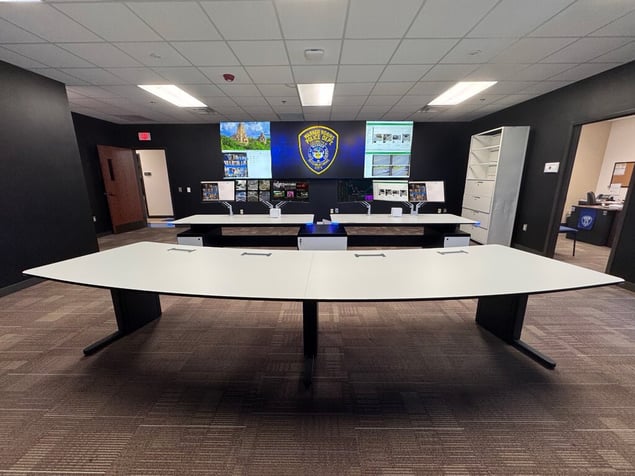
The project involved approximately $257,000 in renovations and technology upgrades, transforming an existing space into a modern, 900-square-foot Real-Time Crime Center at the Law Enforcement Center.
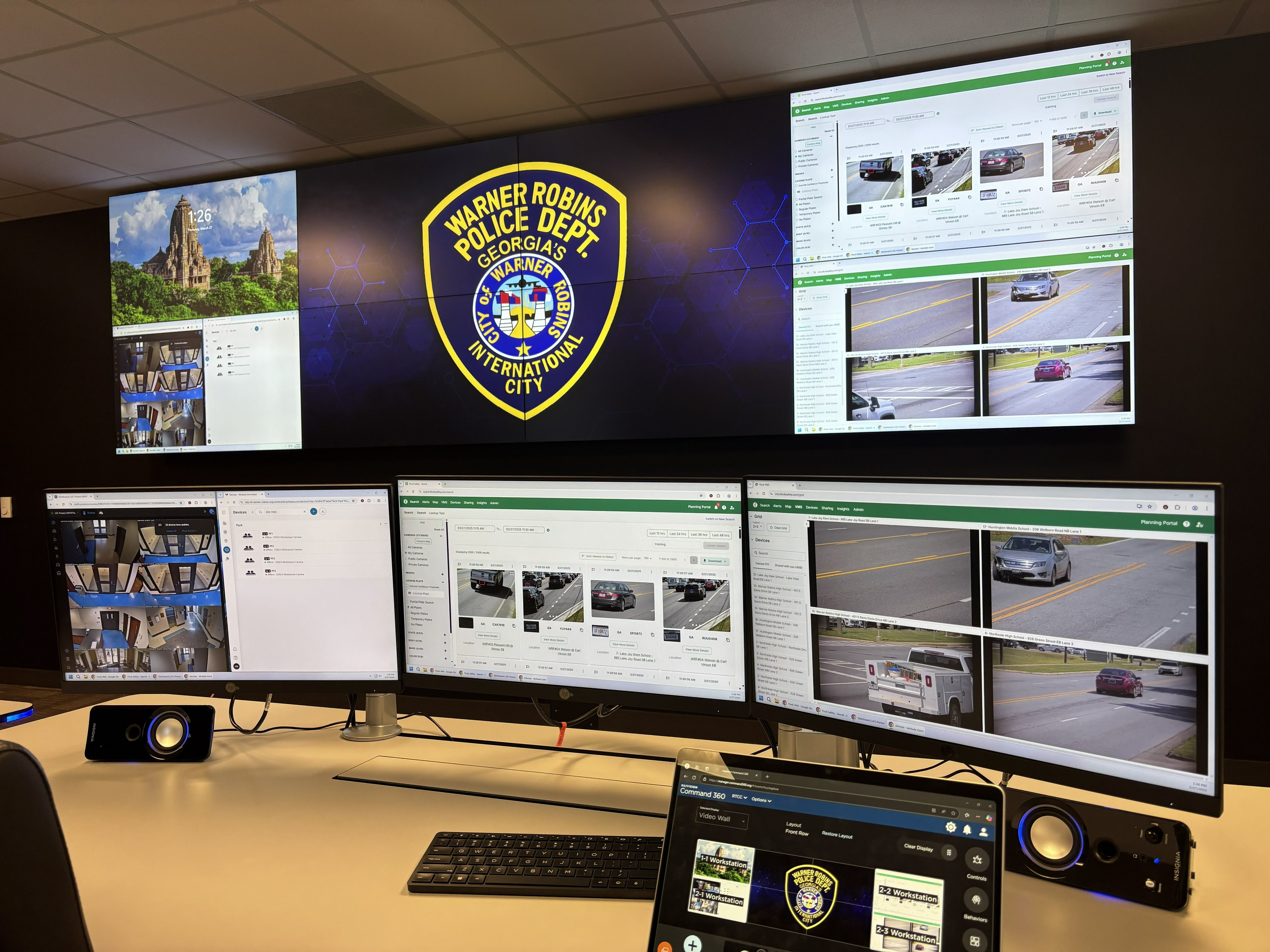
At the center of the installation is Haivision Command 360 and an LG LCD thin bezel video wall solution. Two operator workstations sit in front of the video wall, with desktop monitors and multiple bring-your-own-device (BYOD) inputs providing additional flexibility.
The system allows operators to bring together multiple video and information sources through a centralized interface. One of the most significant capabilities is the ability to view up to 16 streams of high-resolution 4K video simultaneously. This gives personnel a much broader view of developing situations than they could achieve using individual desktop monitors alone.
The infrastructure behind the system was equally important. Solutionz installed nearly 2,000 feet of Category 6 cabling to connect the RTCC to the department's central IT closet. The deployment also included two 24/7-rated operator desks, fully networked PCs, and videoconferencing capabilities.
The result was an integrated environment designed around the department's actual operational needs.
Designing Around the Mission
Every public safety agency has different operational requirements. A large metropolitan department may need to coordinate thousands of camera feeds across multiple precincts, while a smaller municipality may prioritize traffic monitoring, license plate recognition, and access to public safety databases.
For an integrator, successful RTCC planning begins with understanding how information moves through the organization. What sources do operators need to monitor? How many people will use the center? What information needs to be visible simultaneously? How will personnel access and control different systems? What future technologies might the department incorporate?
These questions influence decisions about display technology, video wall processing, signal distribution, network infrastructure, workstation configurations, and room design.
The video wall is often the most visible component, but it is only one part of the larger ecosystem.
Solutions such as Haivision Command 360 allow operators to manage multiple sources through a single interface, while integrated control and KVM capabilities help simplify access to different systems. Display selection also matters, particularly in environments where personnel need to interpret information clearly throughout long operating shifts.
The objective is to make technology work together in a way that supports faster access to information and more effective decision-making. Heather Kireta, Senior Account Manager with Solutionz, states, “A Real-Time Crime Center is ultimately about serving the community. When law enforcement has access to the right information at the right time, officers can respond with greater awareness, make more informed decisions, and better protect the people they serve. That's the real impact of bringing these technologies together."
Building for Reliability and Future Expansion
RTCCs are mission-critical environments. Technology interruptions can affect an operator's ability to access information when it matters most. That makes reliability, infrastructure, and long-term planning essential considerations.
An integrated system must account for connectivity, signal integrity, equipment placement, network requirements, and the ability to manage multiple sources without introducing unnecessary complexity.
Scalability is equally important. As agencies expand their surveillance networks, introduce drone programs, or incorporate additional data sources, their technology environments must be able to accommodate those changes.
At Warner Robins, the department is already looking toward its next phase of development, including the potential integration of Drone as First Responder (DFR) technology operated from the center. Planning for these possibilities during the initial design process can help agencies make more informed technology investments and avoid unnecessary infrastructure changes as requirements grow.
For integrators, this means approaching each project with an understanding of both immediate operational priorities and the agency's longer-term objectives.
Technology That Supports Better Public Safety Outcomes
Since the Warner Robins RTCC became operational, the department has reported improvements in response times and officer safety. Greater visibility into developing situations helps officers understand what they may encounter before arriving on scene.
The center has also contributed to investigations. According to a department captain, two homicide cases benefited from the center's capabilities and may not have been resolved as quickly without it. These outcomes demonstrate the practical value of bringing information together in a centralized environment.
The broader adoption of RTCCs reflects a shift in how law enforcement agencies approach technology. Rather than relying on disconnected systems and individual monitoring points, agencies are investing in integrated environments that help personnel access information, collaborate, and respond with greater awareness.
The Warner Robins project illustrates what thoughtful technology integration can accomplish. Solutionz Account Executive, Doug Wunsch, said, "By combining video wall technology, network infrastructure, operator workstations, and centralized content management, we helped the department establish an environment aligned with its operational priorities."
As public safety technology continues to advance, the value of an RTCC will depend on how effectively those resources work together.
At Solutionz, we help public safety organizations plan and integrate the technology infrastructure behind connected, reliable command and control environments. From full system design, network infrastructure considerations, AV and furniture integration, to long term technology support, our focus is bringing complex systems together to simplify operations and improve the experience of the people who depend on them every day.