Artificial intelligence (AI) is becoming an important consideration for police departments planning new Real-Time Crime Centers (RTCCs) or modernizing existing facilities. From AI-assisted video search to automated alerts and video analytics, emerging technologies offer new opportunities to locate relevant information, strengthen situational awareness, and support public safety operations.
However, implementing AI-enabled capabilities involves more than selecting a software platform. The effectiveness of these technologies also depends on the audiovisual (AV) infrastructure, video walls, control systems, and operator workflows supporting the command center.
As police departments prepare for 2027 and beyond, evaluating their existing RTCC technology infrastructure is an important step toward making informed investments.
The question is not simply what AI can do, but whether a department's Real-Time Crime Center can effectively display, manage, and share the information these technologies provide.
Here are five priorities police departments should consider when planning an AI-ready RTCC.
1. Align AI Investments With Operational Needs
AI-assisted technologies can help RTCC operators search recorded video, identify potentially relevant activity, and review information from supported systems. However, their value depends on how effectively they address existing operational challenges.
For example, a department experiencing delays when reviewing surveillance footage may benefit from AI-assisted video search capabilities. Another may need to improve how information from multiple applications is organized and shared during an incident.
Before investing in new Real-Time Crime Center technology, departments should evaluate their existing workflows and identify where personnel spend unnecessary time accessing, reviewing, or communicating information.
Key questions include:
- Which operational tasks create the greatest delays?
- What information do operators need to access during an incident?
- Can existing systems display and share that information efficiently?
- How will proposed AI capabilities integrate with current RTCC operations?
- Software licensing, updates, and maintenance.
- Operator training and technical support.
- Data access, privacy, and information security requirements.
- Procedures for reviewing and validating AI-generated results.
- Compatibility with existing AV and command center systems.
These questions help departments establish clear technology requirements before evaluating potential solutions.
An effective AI strategy begins with defined operational needs, not a list of available software features.
2. Prepare Video Walls for AI-Enabled Workflows
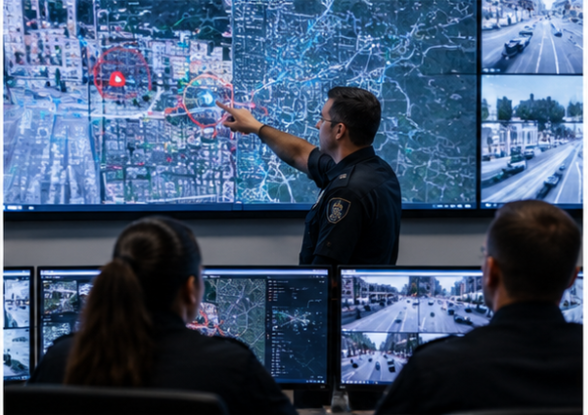
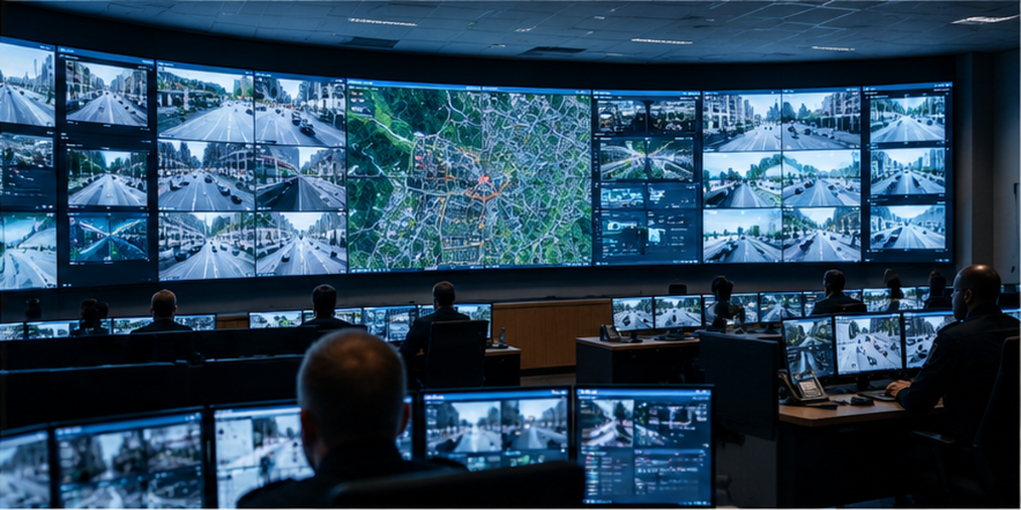
Video walls are an important component of many police command centers, providing shared visibility into surveillance footage, geographic information, and incident activity.
As RTCCs incorporate AI-enabled video analytics and additional information sources, their AV systems must support more than traditional camera feeds.
Operators may need to view live video alongside interactive maps, automated alerts, computer-aided dispatch (CAD) information, and other incident details, depending on the platforms available to the department.
The challenge is not simply displaying more information. It is ensuring the right information is accessible and understandable when personnel need it.
Consider an operator receiving an alert from an AI-enabled video analytics platform. Evaluating that alert may involve reviewing the associated camera feed, identifying its location on a map, and sharing relevant information with other personnel in the command center.
If these tasks require navigating multiple applications or complicated controls, the workflow can become unnecessarily time-consuming.

When evaluating RTCC video wall solutions, departments should consider display visibility, flexible layouts, reliable content routing, and intuitive control systems.
A well-designed command center AV system should make it easier to move relevant information from individual operator workstations to shared displays while preserving the context needed for effective collaboration.
Ultimately, video wall technology should support situational awareness and operational coordination without adding unnecessary complexity.
3. Evaluate Existing RTCC AV Infrastructure and System Integration
Many Real-Time Crime Centers have expanded over time, incorporating additional surveillance cameras, software platforms, workstations, and displays as departmental requirements evolve.
Although these systems may operate effectively on their own, introducing AI-enabled applications can create new compatibility, connectivity, and processing requirements.
For example, an existing AV system designed primarily for displaying camera feeds may need additional capabilities to accommodate analytics dashboards, interactive maps, or new video sources.
One of the most important considerations in RTCC modernization is ensuring that new technologies integrate reliably with existing infrastructure.
Departments should evaluate how information moves between individual workstations, video management systems (VMS), AV distribution equipment, and shared video walls.
Depending on the environment, this may involve reviewing network capacity, supported video formats, available inputs and outputs, control system compatibility, and content-sharing requirements.
Before committing to new technology, departments should ask vendors and integration partners to demonstrate how proposed solutions will operate within their existing RTCC environment.
Testing realistic workflows early in the planning process can help identify potential integration challenges before deployment.
For some departments, targeted AV infrastructure upgrades may provide the necessary functionality without requiring a complete command center redesign.
4. Plan for Responsible AI Use, Training, and Long-Term Support
Introducing AI into a law enforcement environment requires careful consideration of how information is accessed, evaluated, and managed.
AI-generated alerts and analytical results may help operators identify information for further review, but these outputs should not be treated as automatically accurate or conclusive.
The National Institute of Standards and Technology (NIST) addresses these considerations in its AI Risk Management Framework, which provides guidance on managing AI-related risks and promoting characteristics such as reliability, security, transparency, privacy, and fairness.
For police departments, these principles reinforce the importance of establishing clear procedures for reviewing AI-generated information, evaluating accuracy and potential bias, protecting sensitive data, and maintaining appropriate human oversight.
AI-assisted findings should support informed decision-making rather than replace professional judgment.
Beyond governance, departments must also consider the ongoing operational requirements associated with new RTCC technology.
These may include:
Reliable operations also depend on the infrastructure supporting these applications. Video walls, content distribution systems, workstations, and control interfaces must continue functioning as operational needs and software platforms evolve.
A long-term support strategy can help departments address technical issues, maintain system performance, and adapt their command centers as requirements change.
5. Prioritize Scalability and Long-Term Flexibility
As public safety technology continues to evolve, scalability is an important consideration for departments investing in Real-Time Crime Center infrastructure.
An RTCC designed around current requirements alone may face limitations when additional applications, camera feeds, workstations, or information sources are introduced.
Planning for future growth begins with understanding the capabilities and limitations of the existing environment.
Departments should consider whether their AV infrastructure supports additional content sources, whether individual components can be upgraded independently, and what equipment or licensing may be required as the command center expands.
Documented integration capabilities, flexible content routing, and modular system designs can help reduce the need for extensive replacement when new technologies are introduced.
For established RTCCs, preparing for AI does not necessarily require a complete facility overhaul.
Targeted improvements to video walls, AV distribution systems, control interfaces, or supporting infrastructure may help address current limitations while providing additional flexibility for future applications.
The most effective approach begins with an assessment of the existing command center, the technologies already in place, and the workflows personnel depend on.
An AI-ready Real-Time Crime Center is not defined by a particular product or software feature. It is defined by its ability to support useful technologies reliably, integrate new capabilities, and adapt to changing operational requirements.
Preparing Your Real-Time Crime Center for 2027 and Beyond
As police departments evaluate AI-enabled technologies, the priority should remain on improving how personnel access, understand, and share information.
AI-assisted video analytics and other emerging capabilities may introduce new opportunities, but their effectiveness depends on the technology infrastructure and operational workflows supporting them.
For departments planning new Real-Time Crime Centers or considering RTCC modernization, evaluating existing AV infrastructure, identifying integration requirements, and establishing a long-term support strategy can help create a stronger foundation for future investments.
Solutionz, Inc. supports police departments with audiovisual technology solutions for Real-Time Crime Centers and public safety command centers.
From RTCC video walls and control system integration to command center modernization and ongoing technical support, Solutionz helps departments evaluate their AV environments and plan improvements that align with their operational needs.
Is your Real-Time Crime Center prepared for what's next?